
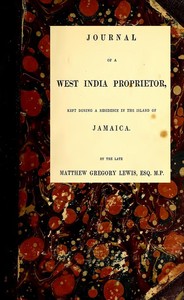
Journal of a West India Proprietor by M. G. Lewis
Matthew 'Monk' Lewis, the author of the creepy classic The Monk, wasn't just a writer of ghost stories. In 1815, he inherited two sugar plantations in Jamaica and decided to see them for himself. Journal of a West India Proprietor is the day-by-day account of his two visits to the island. He writes about the weather, the landscape, and the exhausting social rounds among other plantation owners. But the heart of the journal is his relationship with the hundreds of enslaved people whose labor funded his life.
The Story
There isn't a traditional plot, but there is a powerful narrative arc. It's the story of Lewis's attempt to be a 'good' master in a fundamentally evil system. He's horrified by the cruelty he sees—the whippings, the brandings—and issues new, kinder rules. He listens to complaints, settles disputes, and tries to provide better food and medical care. Yet, he's also frustrated when his 'paternal' efforts don't create the gratitude he expects. The journal shows his constant struggle: he wants to ease suffering but can't imagine a world without the slavery that causes it. His journey is punctuated by dramatic events, from a major slave rebellion on a neighboring estate to a terrifying hurricane, all recorded with a novelist's eye for detail.
Why You Should Read It
This book is gripping because of its glaring contradictions. Lewis is the narrator, and he wants us to see him as a decent man. That makes his casual notes about buying people or his complaints about 'lazy' workers even more jarring. You're not reading a history book's summary; you're inside the mind of someone living it. You see how a person can recognize atrocity and yet be completely blinded by their own privilege and economic interest. It's a masterclass in unreliable narration, not because Lewis is lying, but because he's so unaware of his own biases. It forces you to think about how our own good intentions can be trapped within broken systems.
Final Verdict
This is a challenging but essential read. It's perfect for readers interested in real historical diaries, the complex roots of colonialism, or anyone who enjoys morally complicated narrators. If you liked the personal perspective of Empire of Pain or the unsettling honesty of a memoir like Educated, you'll find this historical journal just as compelling. Be warned: it's not an easy feel-good story. It's a stark, primary-source window into a brutal past, and its uncomfortable power stays with you long after you finish the last page.
This book is widely considered to be in the public domain. Share knowledge freely with the world.
Christopher Williams
3 months agoThe information is current and very relevant to today's needs.
Patricia Thomas
4 months agoAs someone working in this industry, I found the insights very accurate.
Patricia Hernandez
2 months agoThis was exactly the kind of deep dive I was searching for, the chapter on advanced strategies offers insights I haven't seen elsewhere. This should be on the reading list of every serious professional.
Charles Miller
3 months agoI took detailed notes while reading through the chapters and the practical checklists included are a great touch for real-world use. I'll be citing this in my upcoming project.




George Thompson
9 months agoIt’s rare to find such a well-structured narrative nowadays, the nuanced approach to the central theme was better than I expected. This should be on the reading list of every serious professional.