
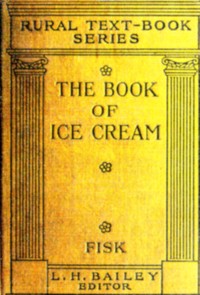
The book of ice-cream by W. W. Fisk
I picked up this old, sun-bleached copy on a whim, drawn in by that simple, joyful title. What I found was a story that felt both incredibly specific to its 1920s setting and completely timeless in its feelings.
The Story
The book follows Arthur Finch, a man of precise routines. His life revolves around his bookkeeping job and, most importantly, his evenings at 'The Frosty Cup,' where he has been perfecting his own ice cream recipe for years. The plot is gentle but sharp. After a personal disappointment, Arthur throws himself completely into his craft. He sources the finest vanilla, calculates the exact freezing time, and achieves what he believes is a masterpiece: a scoop that embodies pure, uncomplicated delight.
The real story begins when he serves it. His best friend tastes it and says it's 'very good.' The shop owner, Mr. Gelato, praises its smooth texture but talks about the cost of cream. Arthur is baffled and then quietly devastated. The novel walks us through his confusion. He starts questioning his own senses, his memories of joy, and whether his pursuit of perfection has walled him off from the messy, shared happiness of ordinary life.
Why You Should Read It
This book surprised me with how much it made me feel. Fisk writes Arthur with such gentle empathy. You don't laugh at his obsession; you understand it. The 'ice cream' is a brilliant symbol for any personal passion—writing, gardening, building models—that means the world to us but can be hard to explain to others. The tension comes from that gap between internal meaning and external reception.
It's also a sharp, subtle look at how men of that era were often taught to channel their emotions into solitary hobbies rather than conversation. Arthur's ice cream is his entire emotional language.
Final Verdict
This is a perfect book for anyone who loves character studies over fast-paced plots. If you enjoy stories about quiet people with rich inner lives, like the works of Anne Tyler or Kent Haruf, you'll find a friend here. It's also a great pick for fans of early 20th-century fiction who want something off the beaten path from the Jazz Age glitz. Don't go in expecting a wild adventure. Go in expecting to spend time with a deeply human, slightly heartbreaking character, and to think about the things you create and who you create them for. It's a small, sweet, and surprisingly potent treat.
No rights are reserved for this publication. You can copy, modify, and distribute it freely.
Kimberly Smith
5 months agoHaving read the author's previous works, the bibliography and references suggest a high level of research and authority. An excellent example of how quality digital books should be formatted.
Robert Hernandez
10 months agoI was skeptical about the depth of this book at first, but the wealth of information provided exceeds the average market standard. A perfect balance of theory and practical advice.
Jackson Gonzalez
1 year agoClear and concise.




Nancy Harris
5 months agoImpressive quality for a digital edition.