About 33 minutes
Quotes and Images from Celebrated Crimes — Reading Companion
Historical Psychological Social Fiction
7,469 recorded words. 5 minutes difference from this book's estimate.
View Gutenberg source #7541
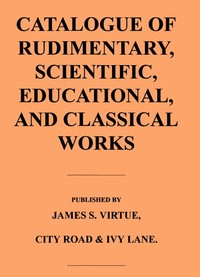
The catalog record for Catalogue of Rudimentary, Scientific, Educational, and Classical Works — Themes and Context provides practical reading context through 6,303 words, 28 min estimated reading time, and 3 detected text sections.
The text analysis averages about 11.9 words per sentence, while the detected sections provide another way to judge how the source is divided.
Project Gutenberg metadata also associates the work with “Booksellers' catalogs -- England -- London,” connecting these edition facts with the source record’s subject description.
Explore this collection
These alternatives are selected using recorded categories and estimated reading time.
About 33 minutes
Historical Psychological Social Fiction
7,469 recorded words. 5 minutes difference from this book's estimate.
View Gutenberg source #7541About 21 minutes
Historical Psychological Social Fiction
4,768 recorded words. 7 minutes difference from this book's estimate.
View Gutenberg source #36434About 17 minutes
Historical Psychological Social Fiction
3,764 recorded words. 11 minutes difference from this book's estimate.
View Gutenberg source #7562Search stored excerpts and compare books → Choose by your preferences →
Choices use stored catalog measurements. Estimates vary with reading speed. A shared category is a catalog label, not a claim that two books have the same argument or literary quality.
Search reads excerpt text stored with this catalog and links to its associated Gutenberg record. The connection is stored in the site database; this tool does not recheck that every excerpt is word-for-word identical to that external record. Excerpt search does not cover every chapter and does not verify historical publication dates.
Catalog snapshot checked: 2026-09-26. Coverage: 96 public books, 96 available source excerpts.
Calculated from edition completeness, EPUB availability, text structure and catalogue metadata. Not a user rating.
Total of 100 points, scaled to a 2.5-5.0 range. Editions with an empty description or a missing EPUB file are not scored.
Public-domain source text
The source text is kept in the dedicated reader, separate from this catalogue record and its commentary.
The catalogue opens with a bold declaration: the entire series is "freely illustrated on wood and stone where requisite." This emphasis on illustration signals that the publisher, James S. Virtue, positioned these books as accessible learning tools, not dry texts. The title page alone lists dozens of subjects—from Natural Philosophy to Domestic Medicine—each priced at one or two shillings, making clear that affordability was central to the enterprise.
The structure is straightforward: entries are grouped into series (Rudimentary, Scientific, Educational, Classical), with each title accompanied by author, price, and occasional binding options. The catalogue's own metadata—a Project Gutenberg record from 2017—adds a layer of historical distance, reminding us that this is a document of Victorian educational commerce.
The Rudimentary Series, the catalogue's backbone, was designed for "Colleges, High and Ordinary Schools, and Self-Instruction." The range is striking: alongside expected titles like Arithmetic and Book-Keeping sit Glass Staining, Painting on Glass, and Domestic Medicine. This mix suggests that "rudimentary" did not mean elementary in a narrow sense, but rather foundational across many trades and arts.
Prices are remarkably consistent. Most volumes cost one shilling, with a few at one shilling sixpence. The catalogue notes that several additional volumes were "in preparation," indicating an ongoing project to expand the series. The inclusion of a Key to Professor J. R. Young's Arithmetic (also 1s. 6d.) hints at a pedagogical system where self-learners could check their work.
The Classical Series is organized by author and book, with Homer's Iliad and Odyssey each split into multiple volumes. For instance, the Iliad appears in four parts (books i–vi, vii–xii, xiii–xviii, xix–xxiv), each priced at 1s. 6d. except the final volume. This serialization allowed buyers to purchase only the sections they needed, a practical approach for schools or self-students.
Notably, several plays by Sophocles, Euripides, and Aeschylus are listed as "Preparing for Press," including Antigone, Ajax, and Agamemnon. The catalogue thus captures a moment of expansion, projecting a complete set of Greek tragedies. The inclusion of Select Lives by Plutarch and Select Idyls by Theocritus broadens the classical offering beyond the core dramatists.
Beyond the series, the catalogue advertises substantial reference works. Tomlinson's Cyclopædia of Useful Arts is described as spanning two volumes, with "40 Engravings on Steel, and 2,477 Woodcuts." The sheer number of illustrations underscores the period's faith in visual instruction. Similarly, Tredgold on the Steam Engine runs to three volumes, priced at £4 14s. 6d.—a significant investment compared to the shilling series.
Other titles target specific professions: Nicholson's Carpenter's Guide, a Dictionary of Terms in Art edited by F. W. Fairholt, and Burnet's Practical Hints on Portrait Painting. These works, priced in shillings rather than pence, were aimed at serious practitioners. The catalogue thus spans from penny primers to expensive encyclopedias, reflecting a stratified market for technical knowledge.
The catalogue's own provenance is part of its interest. It was produced by James S. Virtue after purchasing "the whole of Mr. Weale's Publications," a note that reveals the consolidation of educational publishing in Victorian London. The Project Gutenberg edition, transcribed from scans provided by the Internet Archive, includes a cover image created by the transcriber—a modern intervention that acknowledges the document's material history.
Transcriber's notes state that "uncertain or antiquated spellings or ancient words were not corrected," preserving the original orthography. This decision allows readers to encounter the text as it appeared, with its period-specific punctuation and hyphenation. The catalogue thus serves dual roles: as a primary source for the history of education and as a snapshot of 19th-century book-trade practices.
Reading this catalogue requires adjusting to its purpose: it is a sales document, not a narrative. The most revealing details are often the smallest—the prices, the repeated phrase "in preparation," the careful listing of binding options. Pay attention to what is included (a manual of photography, then new) and what is absent. The catalogue's own structure, grouping works by series and price, mirrors the Victorian impulse to classify and democratize knowledge. Approach it as a window into how learning was packaged and sold.
I keep thinking about that old catalogue—hundreds of plain textbooks, each promising a door into some quiet corner of knowing. It felt less like a list, more like a room of possible selves. Then I found Whittaker & Co.'s List of Classical, Educational and Technical Works. July 1889 — A Reader’s Guide, and something settled. Same gentle arithmetic of ambition, same hush between the price and the promise. A good companion for that feeling.
Capture what you thought, learned, and would like to remember.







![Cover of Publications of the Society for Promoting Christian Knowledge [1902 Catalog] — Inside the Classic](https://rrola.com/storage/media/covers/pg36434.jpg)