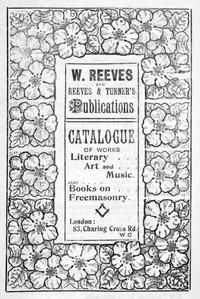
The catalogue opens with a dense block of musical titles, each reduced to composer, arranger, price, and a few descriptive words: 'Chopin's Nocturne (Op. 9, No. 2) 1s. 6d. E. H. Lemare.' This telegraphic style dominates the early pages, where entries for organ voluntaries, marches, and overtures are compressed into near-tabular form. The pace is brisk, the voice impersonal—a simple inventory of goods.
But as the catalogue moves toward literary works, the prose expands. The entry for William Hone's Ancient Mysteries runs to several lines, describing 'English Miracle Plays founded on the Apocryphal New Testament Story' and listing 'notices of Ecclesiastical Shows and Festivals of Fools and Asses.' The shift from list to paragraph signals a change in intended audience: from musicians scanning for scores to bibliophiles seeking scholarly editions.
From Inventory to Advertisement
The catalogue's first half treats each item as a commodity: title, format, price. Entries for manuscript music paper specify '12 Staves, roy. 8vo (10 by 6-1/2) ruled plain in quires (120 sheets), the lot 2/6.' The language is functional, almost mechanical. But when the catalogue reaches Montaigne's Essays & Letters, the tone shifts. The entry boasts of 'An Entirely New Edition formed from a Collation of the Foreign Quotations; a fresh English rendering and a careful revision of the text throughout.' Here, the publisher becomes a salesman, emphasizing scholarly labor and rarity: 'now extremely scarce.'
This contrast in voice is not accidental. The musical listings assume a buyer who knows what 'Op. 9, No. 2' means; the literary entries must persuade. The catalogue thus enacts a dual narrative: one of efficient supply, another of cultural prestige.
Recurring Patterns in Musical Listings
Within the musical sections, certain structural habits recur. Many entries group works by composer or genre under a bolded heading—'ORGAN MUSIC,' 'King's Royal Album,' 'Modern Church Music.' Sub-items are numbered or bulleted, as in the list of twelve voluntaries by J. E. Newell, each with a title like 'Postludium' or 'Recessional March.' The effect is a rhythm of classification: the catalogue imposes order on a sprawling repertory.
Pricing is always explicit, often with parenthetical notes: '(All with ped. obb.)' or '(Prices Music-net).' The word 'net' signals trade discount practices. A few entries include evaluative phrases—'This is pre-eminently the Musical Students' Paper'—but such endorsements are rare. Most listings trust the title and price to sell.
The Literary Turn and Its Rhetoric
When the catalogue moves beyond music, its sentences lengthen and its claims grow grander. The entry for Hone's Apocryphal New Testament announces 'in 4 Volumes, 8vo. Price £2 2s. Handsomely bound in designed buckram cloth.' A note follows: 'One Hundred Copies specially printed on hand-made paper supplied By Spalding & Hodge. Price £4 4s. net, bound in Vellum.' The specificity of the limited edition—the number of copies, the paper source, the binding material—creates an aura of exclusivity absent from the musical listings.
Similarly, the Montaigne entry emphasizes editorial labor: 'Mr. Hazlitt's Montaigne,—An entirely new Edition text ... has now been brought to completion.' The dash and italicized title mimic a publisher's announcement. These literary entries adopt a persuasive, almost scholarly voice, while the musical ones remain briskly commercial.
Readers of this catalogue will find two documents in one: a quick-reference price list for sheet music and a promotional brochure for fine editions. The shift in register—from curt itemization to expansive description—mirrors the different markets Reeves & Turner served. Pay attention to the headings: they signal not just content but the intended reader. The musical pages assume expertise; the literary pages assume aspiration.
I kept thinking about that old catalogue after closing it—how quietly descriptions shifted from bare lists to coaxing words, like someone learning to whisper. It reminded me of another, Whittaker & Co.'s List of Classical, Educational and Technical Works. July 1889 — A Reader’s Guide, where the same gentle change happens. Odd how a publisher's inventory can feel so human, so tender. I wondered if you'd notice it too.








![Cover of Publications of the Society for Promoting Christian Knowledge [1902 Catalog] — Inside the Classic](https://rrola.com/storage/media/covers/pg36434.jpg)