
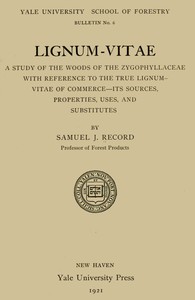
Lignum-vitae : a study of the woods of the Zygophyllaceae with reference to…
Let's get this out of the way: this isn't a novel. There's no protagonist in the traditional sense, unless you count the wood itself. The 'plot' of Samuel J. Record's Lignum-vitae is the quest for clarity in a world of confusion. For a material so historically important—think British naval supremacy relying on its self-lubricating properties—its botanical identity was a total mess.
The Story
The book is Record's attempt to sort it all out. He acts as a guide, leading us through a tangled forest of names, species, and physical characteristics. The story unfolds through meticulous examination: What do the microscopic cells look like? How does the wood from Jamaica differ from Panama? He cross-references herbarium samples, old trade records, and the practical experiences of woodworkers. The conflict is between common use (any hard, dense wood might get called Lignum Vitae) and scientific truth (only specific trees qualify). The resolution is a detailed, evidence-based map of which woods are the real deal, and which are impressive impostors.
Why You Should Read It
I loved this book for its quiet passion. Record isn't just listing facts; he's solving a puzzle that frustrated experts for generations. You feel his respect for the material—a substance tough enough to build empires. The real magic is how it connects dots: a botanical study in a lab explains why a 17th-century warship could sail longer without repair. It makes you look at everyday objects—and the natural world—with new eyes. What other materials have hidden, world-changing stories?
Final Verdict
This is a niche book, but a brilliant one. It's perfect for history buffs who enjoy material science, woodworkers with a curious mind, or anyone who loves a good, factual mystery. If you enjoy authors like Mark Kurlansky (who writes histories of salt or cod) or the hidden-world explorations of Robert Macfarlane, you'll appreciate Record's deep focus. It requires a bit of patience, but the reward is a profound understanding of how one extraordinary tree shaped human history. Don't expect a beach read; do expect to become the person who fascinatingly explains what 'Lignum Vitae' really means at parties.
This is a copyright-free edition. You are welcome to share this with anyone.
James Lopez
8 months agoSolid information without the usual fluff.
William Martinez
11 months agoI started reading this with a critical mind, the author clearly has a deep mastery of the subject matter. I'll be citing this in my upcoming project.
Susan White
11 months agoI've gone through the entire material twice now, and the step-by-step breakdown of the methodology is extremely helpful for students. I'm genuinely impressed by the quality of this digital edition.
Kimberly Harris
5 months agoI have to admit, the character development leaves a lasting impact. One of the best books I've read this year.



Thomas Miller
11 months agoThis was exactly the kind of deep dive I was searching for, it manages to maintain a consistent flow even when discussing difficult topics. I'll be citing this in my upcoming project.