About 33 minutes
ERPANET Case Study: Project Gutenberg — Themes and Context
Fantasy Juvenile Worlds
7,377 recorded words. 4 minutes difference from this book's estimate.
View Gutenberg source #14585
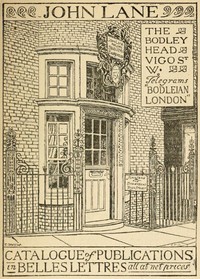
The source record for List of Books in Belles Lettres Published by John Lane, The Bodley Head, 1895 — A Closer Reading measures this digital text at 6,603 words, 29 min estimated reading time, and 2 detected text sections.
The text analysis averages about 11.1 words per sentence, while the detected sections provide another way to judge how the source is divided.
Project Gutenberg metadata also associates the work with “Publishers' catalogs -- England -- London,” connecting these edition facts with the source record’s subject description.
Explore this collection
These alternatives are selected using recorded categories and estimated reading time.
About 33 minutes
Fantasy Juvenile Worlds
7,377 recorded words. 4 minutes difference from this book's estimate.
View Gutenberg source #14585About 33 minutes
Fantasy Juvenile Worlds
7,464 recorded words. 4 minutes difference from this book's estimate.
View Gutenberg source #30557About 35 minutes
Fantasy Juvenile Worlds
7,979 recorded words. 6 minutes difference from this book's estimate.
View Gutenberg source #36649Search stored excerpts and compare books → Choose by your preferences →
Choices use stored catalog measurements. Estimates vary with reading speed. A shared category is a catalog label, not a claim that two books have the same argument or literary quality.
Search reads excerpt text stored with this catalog and links to its associated Gutenberg record. The connection is stored in the site database; this tool does not recheck that every excerpt is word-for-word identical to that external record. Excerpt search does not cover every chapter and does not verify historical publication dates.
Catalog snapshot checked: 2026-09-26. Coverage: 96 public books, 96 available source excerpts.
Calculated from edition completeness, EPUB availability, text structure and catalogue metadata. Not a user rating.
Total of 100 points, scaled to a 2.5-5.0 range. Editions with an empty description or a missing EPUB file are not scored.
Public-domain source text
The source text is kept in the dedicated reader, separate from this catalogue record and its commentary.
The 1895 catalogue from John Lane at The Bodley Head is a document of literary commerce and aesthetic ambition. It lists books in belles lettres, all at net prices, with many titles designated as limited editions—a practice that signals both exclusivity and the publisher's cultivation of a discerning readership. The catalogue is structured as a continuous alphabetical list by author, but within that framework, it groups titles into series such as the Keynotes Series, the Mayfair Set, and Pierrot's Library, each with its own character. Recurring details include the naming of designers for title-pages and covers—Laurence Housman, Patten Wilson, Aubrey Beardsley—underscoring the Bodley Head's integration of visual art and literature. The catalogue also notes American co-publishers, reflecting transatlantic distribution networks.
The catalogue organizes many titles into named series, each with a distinct identity. The Keynotes Series, for instance, includes works by Grant Allen, Evelyn Sharp, and Netta Syrett, often with provocative titles like The Woman who Did and Nobody's Fault. The Mayfair Set offers lighter fare, such as G. S. Street's The Autobiography of a Boy and H. G. Wells's Select Conversations with an Uncle. The Pierrot's Library features H. de Vere Stacpoole's Pierrot and Death, the Knight and the Lady, suggesting a thematic link to commedia dell'arte. This series structure imposes a coherence on the list, grouping works by tone or intended audience, and it allows the publisher to market multiple titles under a recognizable banner.
Throughout the catalogue, each entry frequently names the designer of the title-page and cover. Laurence Housman designed for Francis Thompson's Poems and Katharine Tynan Hinkson's Cuckoo Songs; Patten Wilson contributed to F. A. Swettenham's Malay Sketches and Henry David Thoreau's Poems of Nature; Aubrey Beardsley is credited for his own The Story of Venus and Tannhäuser and for H. T. Wharton's Sappho. This consistent attribution elevates the book as a physical object, aligning the Bodley Head with the Arts and Crafts movement and the aesthetic of the 1890s. The catalogue itself becomes a record of collaborations between writers and visual artists, a network of creative partnerships.
The catalogue repeatedly specifies print runs and net prices. Grant Allen's The Lower Slopes is limited to 600 copies; many entries note that the numbers do not include copies sent to public libraries or for review. The phrase net prices appears prominently, indicating a shift away from the traditional trade discount system. This pricing strategy, combined with limited editions, positions the Bodley Head's publications as collectible items. The catalogue also reserves the right to reprint or issue American editions, showing a careful management of scarcity and market reach. These details offer insight into the economics of late-Victorian literary publishing, where small press runs and designer bindings catered to a niche audience.
Many entries list American co-publishers: Stone & Kimball, Copeland & Day, Macmillan & Co., and others. This reflects the Bodley Head's strategy of simultaneous publication in England and America, expanding its market. The catalogue also includes numerous titles marked In preparation, such as John Buchan's Musa Piscatrix and Robert Bridges' Suppressed Chapters. These forthcoming works create a sense of anticipation and signal the publisher's ongoing program. The presence of both established authors (Robert Louis Stevenson, William Watson) and emerging ones (H. G. Wells, Francis Thompson) shows the Bodley Head's role in shaping the literary landscape of the 1890s, bridging the fin de siècle and the Edwardian era.
This catalogue is best read not as a simple list but as a cultural artifact that maps the intersections of literature, design, and commerce in the 1890s. The recurring emphasis on limited editions, designer credits, and series groupings reveals a publisher consciously constructing a brand. Readers interested in book history, the aesthetic movement, or the business of publishing will find in these pages a wealth of specific detail. The catalogue's structure—alphabetical yet punctuated by series—mirrors the dual nature of the Bodley Head's output: individual works of art and coordinated commercial ventures.
Create a short personal record of your experience with this book.









![Cover of Selected List of Nimmo, Hay, & Mitchell's Publications [1890] — Text and Context](https://rrola.com/storage/media/covers/pg36649.jpg)