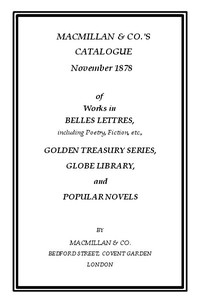
The catalogue opens with a title page that situates the firm at Bedford Street, Covent Garden, London, in November 1878. The contents are organized alphabetically by author, with each entry listing title, author, format, price, and often a brief critical quotation. For instance, Matthew Arnold's Poetical Works appears in two volumes at 7s. 6d. each, while the Golden Treasury edition of his selected poems costs 4s. 6d. The catalogue also includes series like Art at Home, edited by W. J. Loftie, with volumes on decoration, music, and dress, each priced at 2s. 6d. and described as reaching multiple thousands in print runs.
Pricing and Format Diversity
The catalogue reveals a wide range of formats and prices, from inexpensive 18mo editions to lavish folios. For example, Shakespeare's Tempest edited by J. M. Jephson is listed at 1s. in 18mo, while a folio half-morocco edition is priced at 4l. 14s. 6d. (over 94 times more). The Golden Treasury Series offers compact, affordable volumes like Matthew Arnold's Selected Poems at 4s. 6d., with a large paper edition at 12s. 6d. This stratification suggests a market catering to both general readers and collectors.
Critical Excerpts as Marketing
Many entries include quotations from periodicals such as the Examiner, Art Journal, Saturday Review, and Westminster Review. For instance, the Art at Home series is praised as 'beyond price as a library of household art' by the Examiner. J. Brunton Stephens's poem Convict Once is called 'as far more interesting than ninety-nine novels out of a hundred' by the Westminster Review. These excerpts serve as endorsements, emphasizing quality and appeal without revealing plot details.
Themes of Domesticity and Travel
The catalogue reflects Victorian interests in domestic improvement and travel. The Art at Home series covers house decoration, music, drawing rooms, dining rooms, bedrooms, and dress, indicating a market for guides on taste and morality. Travel works include J. Beavington Atkinson's An Art Tour to the Northern Capitals of Europe (12s.) and Sir Samuel Baker's adventure tale Cast Up by the Sea (6s.). These titles suggest a readership curious about both foreign places and the refinement of home life.
Readers approaching this catalogue should note that it is a primary source for Victorian publishing history, not a reading guide. The entries provide evidence of how books were marketed, priced, and reviewed. The critical excerpts, while brief, offer contemporary reception. The catalogue's alphabetical arrangement and consistent format make it easy to browse for specific authors or series. It is best used as a reference for studying the material culture of 1870s book production.
Thumbing through that 1878 Macmillan catalogue, I’m reminded how catalogues themselves are quiet biographies—lists of what people once held dear. There’s a similar breath in the Encyclopaedia Britannica, 11th Edition, Prependix of Volume 7 [Constantine Pavlovich to Demidov] Volume 7, Slice 1 — Themes and Context, where even a slice of entries feels like a shelf of lives waiting patiently, each a small, sturdy friend.








![Cover of Encyclopaedia Britannica, 11th Edition, Prependix of Volume 7 [Constantine Pavlovich to Demidov] Volume 7, Slice 1 — Themes and Context](https://rrola.com/storage/media/covers/pg30976.jpg)

