
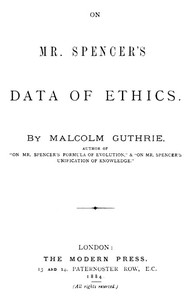
On Mr. Spencer's Data of Ethics by Malcolm Guthrie
Okay, let's be honest: a book with a title like On Mr. Spencer's Data of Ethics doesn't scream 'page-turner.' But Malcolm Guthrie's review is way more accessible than it sounds. He's taking on the giant ideas of Herbert Spencer, one of the most famous thinkers of the Victorian age. Spencer tried to build a system of ethics using logic and science, almost like a math equation for morality.
The Story
There isn't a plot with characters in the usual sense. The 'story' is the clash of ideas. Guthrie walks us through Spencer's argument step-by-step. Spencer believed that as society evolves, our moral sense naturally improves toward a more perfect, peaceful state. He thought we could use facts and observation to figure out the 'right' way to behave. Guthrie listens carefully, explains it clearly, and then pushes back. He questions whether this logical system can really capture the messy, emotional heart of why we care about goodness. It's like watching a respectful but firm debate.
Why You Should Read It
I loved this because it makes you think without being intimidating. Guthrie writes like someone trying to figure things out, not someone who has all the answers. His big question—is morality a science or something more human?—still matters today. We still argue about whether ethics are universal rules or personal feelings. Reading Guthrie feels like finding the origins of a conversation we're still having. It's also a great snapshot of a time when people were wildly optimistic about science's power to explain everything, even our souls.
Final Verdict
This isn't for everyone. If you want a fast-paced novel, look elsewhere. But if you're curious about philosophy, history, or the roots of our modern ideas about right and wrong, give it a chance. It's perfect for readers who enjoy authors like Sarah Bakewell, who make intellectual history feel personal and urgent. Think of it as a short, smart brain workout that connects directly to today's big questions about how we should live.
This content is free to share and distribute. Knowledge should be free and accessible.
Barbara Martinez
1 year agoI decided to give this a try based on a colleague's recommendation, the chapter on advanced strategies offers insights I haven't seen elsewhere. Truly a masterpiece of digital educational material.
Donald Harris
6 months agoWhile browsing through various academic sources, the case studies and practical examples provided add immense value. Top-tier content that deserves more recognition.
Patricia Taylor
9 months agoThis was exactly the kind of deep dive I was searching for, the way the author breaks down the core concepts is remarkably clear. Top-tier content that deserves more recognition.
Jennifer Gonzalez
1 year agoWhile browsing through various academic sources, the language used is precise without being overly academic or confusing. It’s a comprehensive resource that doesn't feel bloated.

George Johnson
2 years agoThe methodology used in this work is academically sound.