About 141 minutes
A Catalogue of Books Published by Methuen and Co., October 1909 — Inside the Classic
Adventure Picaresque Fiction
32,359 recorded words. 1 minutes difference from this book's estimate.
View Gutenberg source #37796
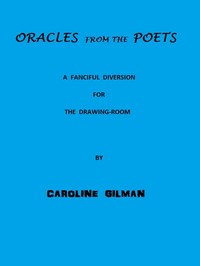
Before opening Oracles from the Poets: A Fanciful Diversion for the Drawing Room — Edition Insights, the edition data offers a quick orientation: 32,164 words, 2 hr 20 min estimated reading time, and 10 detected text sections.
The text analysis averages about 20.9 words per sentence, while the detected sections provide another way to judge how the source is divided.
Project Gutenberg metadata also associates the work with “Amusements,” connecting these edition facts with the source record’s subject description.
Explore this collection
These alternatives are selected using recorded categories and estimated reading time.
About 141 minutes
Adventure Picaresque Fiction
32,359 recorded words. 1 minutes difference from this book's estimate.
View Gutenberg source #37796About 134 minutes
Adventure Picaresque Fiction
30,707 recorded words. 6 minutes difference from this book's estimate.
View Gutenberg source #32997About 103 minutes
Adventure Picaresque Fiction
23,527 recorded words. 37 minutes difference from this book's estimate.
View Gutenberg source #17202Search stored excerpts and compare books → Choose by your preferences →
Choices use stored catalog measurements. Estimates vary with reading speed. A shared category is a catalog label, not a claim that two books have the same argument or literary quality.
Search reads excerpt text stored with this catalog and links to its associated Gutenberg record. The connection is stored in the site database; this tool does not recheck that every excerpt is word-for-word identical to that external record. Excerpt search does not cover every chapter and does not verify historical publication dates.
Catalog snapshot checked: 2026-09-26. Coverage: 96 public books, 96 available source excerpts.
Calculated from edition completeness, EPUB availability, text structure and catalogue metadata. Not a user rating.
Total of 100 points, scaled to a 2.5-5.0 range. Editions with an empty description or a missing EPUB file are not scored.
Public-domain source text
The source text is kept in the dedicated reader, separate from this catalogue record and its commentary.
Caroline Gilman's Oracles from the Poets (1844) is a parlor game that turns poetic quotations into fortune-telling devices. The preface explains that the idea arose from watching a child's fascination with a common fortune-teller; Gilman then spent six months compiling verses from a wide range of poets, from Shakespeare and Milton to contemporaries like N. P. Willis and Mrs. Follen. The book is dedicated to her children, and the instructions direct players to select a number, then read the corresponding oracle aloud. The excerpts reveal a structure of numbered entries, each a short quotation followed by a prose interpretation or application.
The preface offers the clearest window into the book's purpose. Gilman writes that she was “led to arrange” the oracles by observing “the vivid interest taken by persons of all ages in a very common-place Fortune-Teller in the hands of a young girl.” This anecdote grounds the work in a specific social scene: a child’s toy sparked a six-month project. She describes the process as “the pebble thrown into the stream; circle after circle formed,” suggesting that the collection grew organically. The dedication “to my children” and the hope of “communicating a portion of this pleasure more extensively” frame the book as an extension of family recreation. Readers should note that the preface does not claim literary importance; it presents the volume as a tool for “rational social enjoyments.”
Though the full instructions are not included in the excerpts, the structure is evident. Each oracle consists of a number, a poetic quotation, and a prose response. For example, entry 19 quotes Drake: “The middle watch of a summer's night, / When earth is dark, but the heavens are bright.” Entry 27 offers Oliver Wendell Holmes’s whimsical line: “When day hath put on his jacket, and around / His burning bosom button'd it with stars.” The quotations are drawn from a mix of canonical and lesser-known poets, including Southey, Moore, Akenside, and Mrs. Follen. The prose sections—not fully shown—presumably interpret the verse as a prediction or advice. The variety of sources suggests Gilman aimed for a broad, polite literary range, avoiding anything too obscure or too modern.
The sampled oracles cluster around times of day and natural scenes. Morning appears repeatedly: “the lucid morning's opening flower” (Miss H. M. Williams), “when little birds begin discourse” (R. H. Dana), and “morning, when the sun pours his first light” (Southey). Evening and night are equally prominent: “the midnight hour, when / Slow through the studious gloom” (Akenside), “when evening's virgin Queen / Sits on her fringed throne serene” (H. K. White), and “a beautiful sunset, when warm o'er the lake” (Moore). This pattern suggests that the oracles were organized by mood or occasion, though the excerpts do not reveal the full arrangement. The recurrence of twilight and dawn may reflect a Romantic sensibility, but Gilman’s selection also includes domestic scenes like “Come, stir the fire, and close the shutters fast” (Cowper).
The prose portions of the oracles are not fully quoted in the excerpts, but the preface and the epigraphs hint at their tone. The title page quotes Shakespeare’s Merchant of Venice: “I am Sir Oracle, / And when I ope my lips let no dog bark,” and Dryden’s Virgil: “The enthusiast Sybil there divinely taught, / Writes on loose foliage inspiration's thought.” These frame the speaker as a playful authority. The prose likely adopts a mock-oracular voice, blending earnest advice with light irony. The audience is clearly the drawing-room: the book is “A Fanciful Diversion for the Drawing Room,” and the preface addresses “the moral movement of the age.” Readers should expect a tone that is polite, slightly didactic, and aware of its own artifice—a game that winks at its own pretensions.
Approach Oracles from the Poets as a period artifact of domestic entertainment, not a serious fortune-telling manual. The excerpts show a careful selection of verse meant to spark conversation and amusement. Gilman’s preface emphasizes the “purest and highest enjoyment” she found in compiling it, and readers may best appreciate the book by imagining it used aloud in a group, with each oracle read and discussed. The literary range—from Shakespeare to Mrs. Follen—reflects the tastes of an educated 1840s household.
Holding Oracles from the Poets, I kept thinking of how its weathered pages once circled a lamplit room, each slip a small bet on fate. That same quiet trust lives in the word-lists gathered by strangers across languages—each column a fortune, really. It made me recall the Moby Multiple Language Lists of Common Words — Context and Discussion, where every translation feels like an old friend’s nod from a distant shore.
Create a short personal record of your experience with this book.







![Cover of Encyclopaedia Britannica, 11th Edition, Prependix of Volume 7 [Constantine Pavlovich to Demidov] Volume 7, Slice 1 — Themes and Context](https://rrola.com/storage/media/covers/pg30976.jpg)

