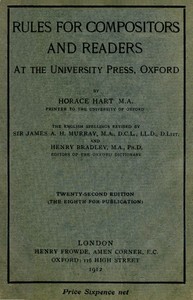
Horace Hart's Rules for Compositors and Readers, in its twenty-second edition (1912), is a working document shaped by the daily demands of the Oxford University Press printing house. The volume opens with a terse directive: these rules apply generally and are only to be departed from when written instructions accompanying copy expressly say otherwise. This insistence on uniformity—tempered by allowance for authorial instruction—sets the tone for a manual that balances prescription with practical flexibility.
The book's authority is reinforced by its revisers: Sir James A. H. Murray and Henry Bradley, editors of the Oxford English Dictionary. Their involvement ensures that the spelling rules reflect the lexicographical standards of the period, while the typographic guidance remains grounded in the physical realities of metal type and hand composition.
Punctuation as a System of Signals
The manual treats punctuation not as mere decoration but as a precise system for clarifying meaning. A footnote recounts a story about Sheridan, who, after giving an opponent the lie direct, apologized with a sentence that could be punctuated two ways: “Mr. Speaker I said the honourable Member was a liar it is true and I am sorry for it.” The anecdote illustrates how punctuation marks can reverse a statement's intent. Hart provides explicit rules for placing commas inside or outside quotation marks depending on whether they belong to the original quotation, and for handling punctuation in classical and philological notes. The examples are drawn from real editorial situations, such as the treatment of lemmas in glossaries: “Falls not , lets not fall” shows a comma after the lemma when a simple definition follows, while a full point is used when the lemma is followed by a complete sentence.
The Voice of the Printing House
Hart's prose is direct and instructional, often addressing the compositor or reader in the second person. The rules are stated as imperatives: “All points are to be omitted from the ends of lines in titles, half-titles, page-headings, and main cross-headings.” This authoritative voice is occasionally leavened by wry footnotes, such as the puzzle passage from the Daily Chronicle—“That that is is that that is not is not is not that it it is”—which, when properly punctuated, becomes “That that is, is; that that is not, is not; is not that it? It is.” The manual also references contemporary style guides by Beadnell, De Vinne, and Allardyce, situating itself within a broader conversation about correct composition. The inclusion of these citations gives the work a scholarly texture, as if the reader is being invited into a community of practitioners.
Typography Across Languages
Although primarily concerned with English, the manual devotes significant attention to French, German, Latin, and Greek text. Appendix III addresses German text in both roman and Fraktur (blackletter) typefaces, noting the use of digraphs—pairs of letters printed as a single type—in Fraktur. The transcriber's note explains that these digraphs, such as [𝔠𝔥] and [ſ𝔱], have no separate Unicode representation and are indicated by bracketed letter pairs. The manual also specifies that the long-s character (ſ) is used in roman lettering for Fraktur text where the blackletter short s would appear. This attention to typographic detail reflects the practical challenges of setting type for multilingual scholarly works, where a single page might require switching between alphabets and typefaces.
Readers approaching this manual should treat it as a period artifact as much as a reference work. The rules reveal the assumptions and conventions of early twentieth-century scholarly publishing, from the treatment of quotations to the handling of footnotes. The book's structure—with rules, examples, and footnotes interleaved—mirrors the layered complexity of the editorial process it describes. For those interested in the history of the book, textual criticism, or the evolution of English style guides, Hart's Rules offers a concrete, unvarnished look at the mechanics of print culture.
There are mornings when a book feels less like reading and more like sitting beside someone patient. Hart’s Oxford rules, with their quiet precision and the editors’ penciled hesitations, reminded me how much care hides inside ordinary craft. That same gentle devotion surfaced again in Concerning Lafcadio Hearn; With a Bibliography by Laura Stedman — Edition Insights, where bibliography itself becomes a kind of affectionate hand-holding across time.