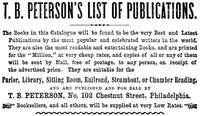
T. B. Peterson's 1857 catalogue is a dense inventory of hundreds of titles, but its real interest lies in the promotional voice that frames each entry. The publisher repeatedly claims his books are the 'very Best and Latest Publications' by 'the most popular and celebrated writers in the world,' and that they are 'printed for the Million, at very cheap rates.' This is not a neutral list; it is a sales pitch that uses repetition, superlatives, and a breathless tone to create urgency. The catalogue also reveals how genre and format were packaged: novels by Mrs. Southworth and Charles Dickens appear alongside medical guides, histories of the Inquisition, and needlework manuals, all at uniform prices of 25 cents to a dollar. The language shifts between grandiose claims—'one of the best and most world-wide celebrated books'—and practical details about bindings and postage.
Repetition and Superlatives as Persuasion
The catalogue's promotional prose relies heavily on stock phrases that appear again and again: 'one of the best books ever written,' 'a beautiful book,' 'a rich treat.' This repetition is not accidental; it creates a rhythm of assurance, as if the publisher is trying to overwhelm the reader with certainty. For instance, Salathiel; or, The Wandering Jew is called 'one of the best and most world-wide celebrated books that has ever been printed,' while The Coquette is simply 'one of the best books ever written.' The same formula is applied to wildly different works—a historical romance, a sea novel, a medical manual—suggesting that the publisher valued consistency of pitch over specificity. The effect is a kind of verbal stamp of approval, repeated until it becomes a refrain.
Pricing, Format, and the Promise of Portability
Every entry includes a price, and many offer a choice between paper covers and cloth binding. The catalogue emphasizes that books can be 'sent by Mail, free of postage,' and that they are 'suitable for the Parlor, Library, Sitting Room, Railroad, Steamboat, or Chamber Reading.' This language positions the books as both domestic comforts and travel companions. The prices are strikingly low: most novels cost 25 to 50 cents in paper, while a dollar buys a cloth-bound volume. The catalogue also notes that some works are 'beautifully illustrated' or 'printed on thicker and better paper,' creating a tiered market. The sheer variety—from The Lady's Work-Table Book to Llorente's History of the Inquisition—suggests that Peterson aimed to supply an entire household's reading needs from a single source.
Voice and Pace in the Promotional Blurbs
The blurbs vary in length and intensity. Some are terse: 'The Spitfire. A Nautical Romance. By Captain Chamier. Illustrated. Price 50 cents.' Others are expansive, like the entry for Wild Oats Sown Abroad, which describes it as 'the Private Journal of a Gentleman of Leisure and Education, and of a highly cultivated mind.' The pace shifts from clipped listings to full sentences that attempt to conjure a scene or promise revelation, as in Mysteries of Three Cities: 'Revealing the secrets of society in these various cities. All should read it.' This variation keeps the catalogue from becoming monotonous, even as the underlying formula remains constant. The most urgent entries use exclamation points and bold claims, while others rely on the authority of the author's name alone.
Reading this catalogue as a document of mid-19th-century print culture, one notices how the publisher's voice shapes the reader's expectations. The constant repetition of 'best,' 'celebrated,' and 'cheap' creates a rhythm that is both persuasive and exhausting. The catalogue is not a neutral list but a performance of confidence, designed to sell not just books but a vision of accessible, portable entertainment. For a modern reader, it offers a glimpse into the marketing strategies that made cheap literature a mass-market phenomenon.
That rainy afternoon, T. B. Peterson's List felt less like a catalogue than a window into train compartments and lamplit parlors, where cheap print was a quiet luxury. I lost myself in the promises of adventure and moral uplift. Later, thumbing through its brittle pages, I stumbled upon a reference that sent me seeking an older, sturdier companion—W. & R. Chambers' Catalogue. - 1897 Books Suitable for Prizes and Presentation — Reading Companion, which offered a gentler, more patient idea of what a book could give a child.










![Cover of Publications of the Society for Promoting Christian Knowledge [1902 Catalog] — Inside the Classic](https://rrola.com/storage/media/covers/pg36434.jpg)