
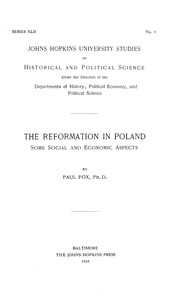
The reformation in Poland : Some social and economic aspects by Paul Fox
Paul Fox's The Reformation in Poland: Some Social and Economic Aspects is not your typical religious history. Forget a simple timeline of new preachers and church doctrines. Fox is interested in the engine room of history: the practical, often gritty, reasons why big ideas succeed or fail.
The Story
Fox sets the stage in the 1500s, when Protestant ideas from Western Europe began flowing into the Polish-Lithuanian Commonwealth. Instead of just following the arguments of theologians, he follows the money and the power. The book shows how the Polish nobility, a massively powerful class, saw the Reformation as a tool. By challenging the Catholic Church, they could weaken a major political rival and, crucially, gain control over vast church lands and wealth. Fox digs into tax records, land deeds, and political decrees to show how this played out in different regions. He contrasts areas where the nobility heavily invested in the new faith with areas where they didn't, painting a picture of a reformation driven as much by property rights and social ambition as by belief.
Why You Should Read It
What I love about this book is how it makes a distant event feel concrete and human. It answers the 'why' behind the 'what.' You understand that a nobleman's choice to support a Lutheran preacher might have been less about salvation and more about securing a nearby forest or avoiding a church tax. It peels back the layer of pure ideology to show the social machinery at work. Fox gives you a real sense of the different groups involved—the calculating magnates, the ambitious gentry, the cautious townsfolk, and the largely silent peasantry—and how each was affected by this religious earthquake. It turns the Reformation from a European event into a series of local Polish dramas with high stakes.
Final Verdict
This is a classic, specialized work. It's perfect for history buffs, particularly those interested in early modern Europe, the Reformation, or Polish history, who are ready to go beyond the big names and look at the underlying forces. It's also great for anyone who enjoys books that connect politics, economics, and culture. Be warned: it's an academic book from the early 20th century, so it's dense and assumes some basic knowledge. But if you're willing to put in the work, it offers incredibly rich insights. You won't find a thrilling narrative here, but you will find a masterful explanation of how the world actually changes.
This historical work is free of copyright protections. Feel free to use it for personal or commercial purposes.
Charles Martin
2 months agoThe research depth is palpable from the very first chapter.
Brian Wright
1 year agoI started reading out of curiosity and the plot twists are genuinely surprising. A true masterpiece.
Michelle Jones
1 year agoA must-have for anyone studying this subject.
Mark Jackson
1 year agoRecommended.




Linda Jones
10 months agoUnlike many other resources I've purchased before, the case studies and practical examples provided add immense value. It definitely lives up to the reputation of the publisher.