About 41 minutes
A Record of Study in Aboriginal American Languages — Context and Discussion
Historical Psychological Social Fiction
9,341 recorded words. 0 minutes difference from this book's estimate.
View Gutenberg source #31351
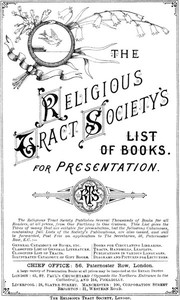
The Religious Tract Society Catalogue - 1889 — Edition Insights can be approached with a clearer sense of reading commitment from its source measurements: 9,214 words, 41 min estimated reading time, and 2 detected text sections.
The text analysis averages about 10.5 words per sentence, while the detected sections provide another way to judge how the source is divided.
Project Gutenberg metadata also associates the work with “Publishers' catalogs -- England -- London,” connecting these edition facts with the source record’s subject description.
Explore this collection
These alternatives are selected using recorded categories and estimated reading time.
About 41 minutes
Historical Psychological Social Fiction
9,341 recorded words. 0 minutes difference from this book's estimate.
View Gutenberg source #31351About 44 minutes
Historical Psychological Social Fiction
10,083 recorded words. 3 minutes difference from this book's estimate.
View Gutenberg source #52405About 45 minutes
Historical Psychological Social Fiction
10,323 recorded words. 4 minutes difference from this book's estimate.
View Gutenberg source #55691Search stored excerpts and compare books → Choose by your preferences →
Choices use stored catalog measurements. Estimates vary with reading speed. A shared category is a catalog label, not a claim that two books have the same argument or literary quality.
Search reads excerpt text stored with this catalog and links to its associated Gutenberg record. The connection is stored in the site database; this tool does not recheck that every excerpt is word-for-word identical to that external record. Excerpt search does not cover every chapter and does not verify historical publication dates.
Catalog snapshot checked: 2026-09-26. Coverage: 96 public books, 96 available source excerpts.
Calculated from edition completeness, EPUB availability, text structure and catalogue metadata. Not a user rating.
Total of 100 points, scaled to a 2.5-5.0 range. Editions with an empty description or a missing EPUB file are not scored.
Public-domain source text
The source text is kept in the dedicated reader, separate from this catalogue record and its commentary.
The Religious Tract Society's 1889 catalogue is not merely a list of books but a document of Victorian evangelical publishing strategy. It presents hundreds of titles organized by author, series, price, and audience—from penny tracts to five-shilling gift editions. The catalogue reveals how the Society balanced moral instruction with commercial appeal, using author names like Mrs. Walton and Hesba Stretton as brands, and grouping books into series such as 'The Boy's Own Bookshelf' and 'Books for Girls.' Price points are meticulously noted, from '1d.' paper covers to '5s.' cloth gilt, showing a tiered market for Sunday schools, libraries, and family gifts.
The catalogue treats authors as recognizable brands. Mrs. Walton's works appear first, with titles like Shadows and A Peep Behind the Scenes priced from 3s. 6d. down to 3d. for a cheap edition. Hesba Stretton's Jessica's First Prayer also appears in a 1d. paper edition, indicating deliberate price differentiation for the same title. Series such as 'The Boy's Own Bookshelf' and 'Books for Girls' group titles by gender and age, with consistent pricing—3s. 6d. for boys' adventure stories, 2s. to 5s. for girls' fiction. The catalogue even includes practical handbooks like Football and Cricket by recognized authorities (Dr. Irvine, W.G. Grace), extending the brand into non-fiction.
The catalogue's price range is extraordinary: from 'One Farthing to One Guinea.' Cheap editions at 1d. or 3d. sit alongside 'Presentation Books' at 5s. with gilt edges. The phrase 'A Cheap Edition may now be had in paper covers, 1d.' for Hesba Stretton's Jessica's First Prayer shows how the Society repackaged popular titles for different buyers. The 'New Series of Half-Crown Books for All Readers' offers 384 pages for 2s. 6d., a deliberate value proposition. This tiered system allowed the Society to reach Sunday schools, circulating libraries, and gift-givers simultaneously, as noted in the list of 'Catalogues' available on request.
Brief descriptions embed moral and religious cues. Mrs. Coote's Grace Trevelyan is subtitled 'Led into Light,' and Rosa Nouchette Carey's Aunt Diana 'illustrates the working of duty founded upon Christian principle.' Other titles like The Master's Service: A Practical Guide for Girls and Servants and Service by Ruth Lamb directly address domestic piety. Even adventure stories—Through Fire and Through Water by T.S. Millington—carry implicit spiritual allegory. The catalogue thus markets not just stories but moral frameworks, aligning entertainment with edification.
Readers approaching this catalogue should note its dual function: as a sales tool and a cultural artifact. The listings reveal what Victorian evangelicals deemed suitable reading for boys, girls, workers, and families. Pay attention to the repeated phrases—'cloth boards, gilt edges,' 'Illustrated'—and the careful calibration of price to audience. The catalogue is a window into the business of moral publishing.
I keep thinking about that old Religious Tract Society catalogue, how each price tier felt like a different door into the same quiet faith. Flipping through it reminded me of another list I stumbled on later, one that had that same unhurried sense of intention. A Classified Catalogue of Selected Works Published by George Bell and Sons November, 1892 — Key Ideas to Explore felt less like commerce and more like a gentle arranging of what matters.
Create a short personal record of your experience with this book.







![Cover of Publications of the Society for Promoting Christian Knowledge [1902 Catalog] — Inside the Classic](https://rrola.com/storage/media/covers/pg36434.jpg)