About 58 minutes
Selected List of Swan Sonnenschein & Co.'s Publications — Story, Setting & Ideas
Science Fiction Utopias
13,219 recorded words. 2 minutes difference from this book's estimate.
View Gutenberg source #40730
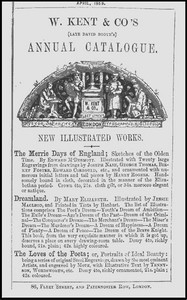
The source record for W. Kent & Co's Annual Catalogue, April 1859 — Reading Notes measures this digital text at 12,765 words, 56 min estimated reading time, and 16 detected text sections.
The text analysis averages about 12.0 words per sentence, while the detected sections provide another way to judge how the source is divided.
Project Gutenberg metadata also associates the work with “Publishers' catalogs -- England -- London,” connecting these edition facts with the source record’s subject description.
Explore this collection
These alternatives are selected using recorded categories and estimated reading time.
About 58 minutes
Science Fiction Utopias
13,219 recorded words. 2 minutes difference from this book's estimate.
View Gutenberg source #40730About 60 minutes
Science Fiction Utopias
13,583 recorded words. 4 minutes difference from this book's estimate.
View Gutenberg source #14359About 48 minutes
Science Fiction Utopias
10,892 recorded words. 8 minutes difference from this book's estimate.
View Gutenberg source #7554Search stored excerpts and compare books → Choose by your preferences →
Choices use stored catalog measurements. Estimates vary with reading speed. A shared category is a catalog label, not a claim that two books have the same argument or literary quality.
Search reads excerpt text stored with this catalog and links to its associated Gutenberg record. The connection is stored in the site database; this tool does not recheck that every excerpt is word-for-word identical to that external record. Excerpt search does not cover every chapter and does not verify historical publication dates.
Catalog snapshot checked: 2026-09-26. Coverage: 96 public books, 96 available source excerpts.
Calculated from edition completeness, EPUB availability, text structure and catalogue metadata. Not a user rating.
Total of 100 points, scaled to a 2.5-5.0 range. Editions with an empty description or a missing EPUB file are not scored.
Public-domain source text
The source text is kept in the dedicated reader, separate from this catalogue record and its commentary.
The catalogue opens with a cluster of heavily illustrated gift books, each entry a compact advertisement for Victorian bookmaking. Binding details—'handsomely bound in cloth, decorated in the manner of the Elizabethan period' for The Merrie Days of England—and price splits between plain and coloured editions (21s. cloth gilt vs. 34s. morocco) signal a market where ornament was a primary selling point. The promotional voice is direct: Dreamland 'deserves a place on every drawing-room table,' a phrase echoed for Milton's L'Allegro and Il Penseroso in a Morning Post quotation. These repeated appeals to domestic display suggest the catalogue's intended audience—middle-class households where books served as both reading matter and furniture.
The catalogue treats binding not as a neutral container but as a selling point. The Merrie Days of England is 'handsomely bound in cloth, decorated in the manner of the Elizabethan period,' while Christmas with the Poets boasts 'numerous Initial Letters and Borders printed in gold.' Prices escalate with ornament: Dreamland costs 21s. plain but 42s. 'highly coloured.' The same work appears in multiple formats—Little Mary's Treasury bundles eight books for 5s. cloth, while the same titles sold individually at 6d. each. This tiered pricing lets buyers choose between economy and display, a strategy that pervades the catalogue.
Children's titles occupy a substantial portion of the catalogue, grouped into series with uniform pricing. The 'Ladder to Learning' series offers six 'Harry's' books at 6d. each, plain, or 1s. coloured. 'Indestructible Books' printed on calico promise durability: Bertie's Indestructible Treasury contains '100 Pictures' for 3s. 6d. The 'Home Books' series splits into Lesson Books and Story Books, each at 1s. plain or 2s. 6d. coloured. Titles like The Well-bred Doll and The Discontented Chickens suggest moral instruction wrapped in entertainment. The catalogue's systematic grouping—by price, format, and subject—reflects a rationalized approach to juvenile publishing.
A series of 'Manuals of Instruction and Amusement' at 1s. each covers flower gardening, chess, music, domestic economy, cage birds, oil painting, butterfly collecting, and water colours. These compact handbooks target hobbyists and self-educators. Drawing books by Mons. Julien, George Childs, J. D. Harding, and others are sold in numbered parts (six numbers at 1s. each, or bound in cloth at 7s. 6d.). Julien's Studies of Heads and The Human Figure are 'Lithographed by T. Fairland,' indicating the use of lithography for art instruction. The catalogue thus documents a thriving market for practical knowledge, from butterfly nets to Euclid.
Prices are stated with precision: 21s. for a quarto, 6d. for a child's picture book, 1s. for a manual. The catalogue rarely uses adjectives like 'cheap' but implies value through bundling—'the Six bound in one volume, 3s. 6d. cloth'—and by noting editions as 'New and Enlarged' or 'Improved Edition.' The phrase 'richly bound' recurs, and the word 'handsome' appears multiple times. These choices frame the books as objects worth owning, not merely reading. The absence of discount or remainder language suggests a stable market where list prices were the norm.
Reading this catalogue as a historical document means attending to what it takes for granted: the expectation that buyers would recognize the value of steel engravings, lithographs, and gilt borders. The entries do not explain these features; they assume a literate consumer. For modern readers, the catalogue offers a concrete record of what a Victorian publisher thought would sell—and how they chose to describe it. The language of ornament, durability, and moral instruction reveals the assumptions behind the books themselves.
Holding that old W. Kent catalogue, I kept thinking how those crisp Victorian listings—gilt edges, price tiers—felt like a quiet promise of tomorrow’s stories. That same hush clings to the Selected List of Swan Sonnenschein & Co.'s Publications — Story, Setting & Ideas, a later echo of the same patient shelf, waiting to be remembered. Both feel less like advertisements, more like a friend’s honest shelf. I smiled, turning the pages.
Capture what you thought, learned, and would like to remember.









