About 86 minutes
Scott, Greenwood Catalogue of Special Technical Works, January 1905 — Edition Insights
Science Fiction Utopias
19,698 recorded words. 3 minutes difference from this book's estimate.
View Gutenberg source #42652
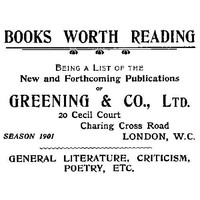
For Books Worth Reading Being a List of the New and Forthcoming Publications of Greening & Co., Ltd, season 1901 — Background and Themes, the stored edition analysis reports 19,012 words, 1 hr 23 min estimated reading time, and 4 detected text sections.
The text analysis averages about 11.0 words per sentence, while the detected sections provide another way to judge how the source is divided.
Project Gutenberg metadata also associates the work with “Publishers' catalogs -- England -- London,” connecting these edition facts with the source record’s subject description.
Explore this collection
These alternatives are selected using recorded categories and estimated reading time.
About 86 minutes
Science Fiction Utopias
19,698 recorded words. 3 minutes difference from this book's estimate.
View Gutenberg source #42652About 86 minutes
Science Fiction Utopias
19,588 recorded words. 3 minutes difference from this book's estimate.
View Gutenberg source #44090About 77 minutes
Science Fiction Utopias
17,566 recorded words. 6 minutes difference from this book's estimate.
View Gutenberg source #37658Search stored excerpts and compare books → Choose by your preferences →
Choices use stored catalog measurements. Estimates vary with reading speed. A shared category is a catalog label, not a claim that two books have the same argument or literary quality.
Search reads excerpt text stored with this catalog and links to its associated Gutenberg record. The connection is stored in the site database; this tool does not recheck that every excerpt is word-for-word identical to that external record. Excerpt search does not cover every chapter and does not verify historical publication dates.
Catalog snapshot checked: 2026-09-26. Coverage: 96 public books, 96 available source excerpts.
Calculated from edition completeness, EPUB availability, text structure and catalogue metadata. Not a user rating.
Total of 100 points, scaled to a 2.5-5.0 range. Editions with an empty description or a missing EPUB file are not scored.
Public-domain source text
The source text is kept in the dedicated reader, separate from this catalogue record and its commentary.
Greening & Co.'s 1901 catalogue presents itself not merely as a list of books for sale but as a curated selection of 'Books Worth Reading,' a phrase that frames the publisher as a gatekeeper of quality. The catalogue's structure—grouping titles under 'General Literature, Criticism, Poetry, Etc.' and then moving to fiction—mirrors the period's hierarchy of genres. Each entry is a miniature advertisement, blending descriptive blurbs with extracts from newspapers like the Daily Telegraph and Spectator. These reviews are not neutral; they are chosen to highlight specific selling points: 'fluent' writing, 'genuine enthusiasm,' or 'intensely interesting' life stories. The catalogue thus becomes a document of Edwardian literary marketing, where the publisher's voice is mediated through the authority of the press.
The catalogue relies heavily on quoted praise from periodicals, but the selections are strategic. For G. F. Monkshood's Rudyard Kipling. The Man and His Work, the Daily Telegraph is quoted praising the author's 'fluent' style and 'intimate acquaintance' with Kipling's work. The Scotsman calls the volume 'well-informed' and 'sincere.' These adjectives—fluent, well-informed, sincere—are not accidental; they construct an image of the book as authoritative yet accessible. Similarly, for T. Edgar Pemberton's Bret Harte, the Whitehall Review is cited for calling it 'a well-balanced, characteristic, and fair estimate.' The catalogue thus curates a chorus of voices that all agree on the books' merits, creating a persuasive echo chamber for potential buyers.
Fiction entries often emphasize excitement and novelty. W. Patrick Kelly's The Dolomite Cavern is described by the Daily Telegraph as full of 'startling situations' and 'the wonders of primitive nature, the marvels of latter-day science.' The review specifically mentions 'Rontgen rays, subterranean torrents, and devastating inundations' as plot devices. This language taps into contemporary fascination with new technologies (X-rays had been discovered only six years earlier) and natural disasters. The catalogue presents such elements as guarantees of entertainment: 'The book is very readable throughout, and ends happily. What more can the average novel reader wish for in holiday time?' The tone is confident, almost cheeky, assuming the reader's desire for thrilling but safe resolutions.
Several entries foreground character portrayal as a key virtue. For Miss Malevolent, the Saturday Review is quoted praising 'a knack of character-presentment which means that his people live.' The phrase 'his people live' suggests a naturalistic, almost photographic realism. The catalogue for An Idol of Bronze claims its characters are 'no loosely-built fancies of the journalistic brain, but portraits—almost snapshot portraits—of men and women of to-day.' The word 'snapshot' is telling: it implies immediacy and authenticity, as if the novel offers unmediated access to real life. This emphasis on lifelike characters aligns with the period's growing interest in psychological realism, even within sensational plots.
Reading this catalogue as a historical document reveals the strategies publishers used to position their wares in a crowded market. The reliance on press excerpts, the balancing of highbrow and popular appeal, and the careful choice of adjectives all reflect a sophisticated understanding of literary marketing. For modern readers, the catalogue offers a snapshot of Edwardian literary culture—what was considered worth reading, and why.
I found myself oddly moved by that old 1901 catalogue—how earnestly it promised what readers might want. It made me think of the quiet trust in lists, in pages meant to guide. There’s a similar gentle intimacy in the University of California Library Handbook 1918-1919 — Edition Insights, a small artifact that simply holds a moment’s careful order, like a friend’s steadying hand.
Use these questions to collect your thoughts before moving on.









