About 86 minutes
Scott, Greenwood Catalogue of Special Technical Works, January 1905 — Edition Insights
Science Fiction Utopias
19,698 recorded words. 0 minutes difference from this book's estimate.
View Gutenberg source #42652
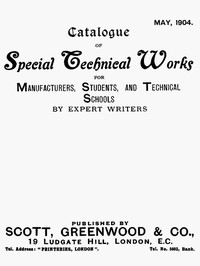
For Catalogue of Special Technical Works for Manufacturers, Students, and Technical Schools. May 1904 — Background and Themes, the stored edition analysis reports 19,588 words, 1 hr 26 min estimated reading time, and 3 detected text sections.
The text analysis averages about 17.7 words per sentence, while the detected sections provide another way to judge how the source is divided.
Project Gutenberg metadata also associates the work with “Publishers' catalogs -- England -- London,” connecting these edition facts with the source record’s subject description.
Explore this collection
These alternatives are selected using recorded categories and estimated reading time.
About 86 minutes
Science Fiction Utopias
19,698 recorded words. 0 minutes difference from this book's estimate.
View Gutenberg source #42652About 83 minutes
Science Fiction Utopias
19,012 recorded words. 3 minutes difference from this book's estimate.
View Gutenberg source #54005About 77 minutes
Science Fiction Utopias
17,566 recorded words. 9 minutes difference from this book's estimate.
View Gutenberg source #37658Search stored excerpts and compare books → Choose by your preferences →
Choices use stored catalog measurements. Estimates vary with reading speed. A shared category is a catalog label, not a claim that two books have the same argument or literary quality.
Search reads excerpt text stored with this catalog and links to its associated Gutenberg record. The connection is stored in the site database; this tool does not recheck that every excerpt is word-for-word identical to that external record. Excerpt search does not cover every chapter and does not verify historical publication dates.
Catalog snapshot checked: 2026-09-26. Coverage: 96 public books, 96 available source excerpts.
Calculated from edition completeness, EPUB availability, text structure and catalogue metadata. Not a user rating.
Total of 100 points, scaled to a 2.5-5.0 range. Editions with an empty description or a missing EPUB file are not scored.
Public-domain source text
The source text is kept in the dedicated reader, separate from this catalogue record and its commentary.
The catalogue opens with a dense index of subjects, from "Agricultural Chemistry" to "Bibliography," each entry a single line of type. The voice is purely functional: a list of commodities for the workshop. But as the entries expand into full descriptions, the prose thickens. A book on enamelling promises to cover "Composition and Properties of Glass—Raw Materials for the Manufacture of Enamels—Substances Added to Produce Opacity." The rhythm is staccato, each dash a new step in a process. The catalogue is not merely a list; it is a compressed library of industrial knowledge, where every title implies a reader who already understands the vocabulary of mordants, degumming, and coal-tar colours.
The catalogue's primary mode is the list, but its pace varies. The index is telegraphic: "Alum and its Sulphates, 9 / Ammonia, 9 / Aniline Colours, 3." No verbs, no articles. Then, in the full entries, the sentences lengthen. A description of a book on paper pulp dyeing includes "157 patterns of paper dyed in the pulp" and a contents list that runs: "Behaviour of the Paper Fibres during the Process of Dyeing, Theory of the Mordant — Colour Fixing Mediums (Mordants) — Influence of the Quality of the Water Used." The dashes create a forward momentum, mimicking the sequential steps of a technical process. The catalogue thus enacts the very logic of the manuals it sells: each step leads to the next.
The language assumes a reader already fluent in trade jargon. Terms like "schapping," "noil spinning," and "exhaust noil spinning" appear without definition. A book on silk waste spinning promises to cover "Silk Waste Degumming, Schapping and Discharging." The catalogue does not explain; it signals expertise. This is not a primer but a tool for professionals. The repeated phrase "strictly net" after prices reinforces the transactional tone. The voice is that of a supplier addressing a buyer who knows exactly what they need. The catalogue's structure—index, then detailed entries—mirrors the way a specialist would search: scan the index, then read the fine print.
The catalogue uses punctuation to control reading speed. The index is a rapid-fire list of nouns. The full entries shift to longer phrases separated by em-dashes, creating a breathless, instructional cadence. For example, the enamelling book's contents: "Composition and Properties of Glass—Raw Materials for the Manufacture of Enamels—Substances Added to Produce Opacity—Fluxes—Pigments." Each dash is a mental pause, a new ingredient in a recipe. The effect is cumulative: the reader builds a mental checklist. In contrast, the book on textile fibres uses a colon and commas: "The Textile Fibres—Washing, Bleaching, Carbonising—Mordants and Mordanting—Dyeing." The variation in punctuation mirrors the different rhythms of different trades—some linear, some branching.
Reading this catalogue requires a shift in attention: from scanning the index for a keyword to parsing the dense contents of a single entry. The pace is set by the reader's own expertise. A dyer might linger on the paper pulp patterns; a weaver might skip to the power-loom section. The catalogue rewards those who already know the language of the workshop. It is a document of its time, but its rhythms—the staccato list, the breathless dash—still speak to how technical knowledge was packaged and sold.
There is something touching about these old catalogues—pages of dye recipes and enamel formulas, each promising permanence. One imagines the reader’s lamp-lit evenings, turning dense technical prose. Nearby, that other list, A Catalogue of Books Published by Methuen and Company, February, 1908 — Text and Context, feels like a neighboring shelf in someone’s vanished study. Both speak of a world that believed paper could hold everything worth knowing.
Create a short personal record of your experience with this book.









