About 79 minutes
A Selection of Books Published by Methuen and Co. Ltd., October 1910 — Background and Themes
Historical Psychological Social Fiction
18,106 recorded words. 4 minutes difference from this book's estimate.
View Gutenberg source #15751
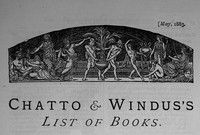
Chatto & Windus's List of Books, May 1883 — Context and Discussion can be approached with a clearer sense of reading commitment from its source measurements: 18,938 words, 1 hr 23 min estimated reading time, and 5 detected text sections.
The text analysis averages about 7.7 words per sentence, while the detected sections provide another way to judge how the source is divided.
Project Gutenberg metadata also associates the work with “Publishers' catalogs -- England -- London,” connecting these edition facts with the source record’s subject description.
Explore this collection
These alternatives are selected using recorded categories and estimated reading time.
About 79 minutes
Historical Psychological Social Fiction
18,106 recorded words. 4 minutes difference from this book's estimate.
View Gutenberg source #15751About 69 minutes
Historical Psychological Social Fiction
15,771 recorded words. 14 minutes difference from this book's estimate.
View Gutenberg source #48631About 65 minutes
Historical Psychological Social Fiction
14,837 recorded words. 18 minutes difference from this book's estimate.
View Gutenberg source #12513Search stored excerpts and compare books → Choose by your preferences →
Choices use stored catalog measurements. Estimates vary with reading speed. A shared category is a catalog label, not a claim that two books have the same argument or literary quality.
Search reads excerpt text stored with this catalog and links to its associated Gutenberg record. The connection is stored in the site database; this tool does not recheck that every excerpt is word-for-word identical to that external record. Excerpt search does not cover every chapter and does not verify historical publication dates.
Catalog snapshot checked: 2026-09-26. Coverage: 96 public books, 96 available source excerpts.
Calculated from edition completeness, EPUB availability, text structure and catalogue metadata. Not a user rating.
Total of 100 points, scaled to a 2.5-5.0 range. Editions with an empty description or a missing EPUB file are not scored.
Public-domain source text
The source text is kept in the dedicated reader, separate from this catalogue record and its commentary.
Chatto & Windus's May 1883 catalogue is a dense inventory of over a hundred titles, each entry compressed into a few lines of type. The list moves alphabetically by author, from Edmond About's The Fellah to works by James Payn and Ouida, with prices and formats—'illustrated boards, 2s.' or 'cloth extra, 7s. 6d.'—repeating like a refrain. The catalogue's voice is purely commercial, yet it offers a snapshot of Victorian reading habits: novels dominate, but there are also dictionaries, histories, and books on hygiene and handwriting. The entries for Ouida, for instance, list nineteen novels, each priced at 5s. in cloth, suggesting a steady market for her romantic fiction. The catalogue's structure—a simple list with occasional notes like 'In preparation' or 'Shortly'—creates a rhythm of anticipation, hinting at the publisher's seasonal output.
The catalogue's pacing is set by its typography and repetition. Each entry begins with the author's name in bold or small caps, followed by a colon and the title, then a dash and the description. For example: 'Adams (W. Davenport), Works by: A Dictionary of the Drama... Crown 8vo, half-bound, 12s. 6d. [In preparation.' The brackets around 'In preparation' add a note of urgency, while the consistent format creates a steady, almost hypnotic beat. This uniformity allows the reader to scan quickly, but the occasional longer entry—like the one for The Agony Column of 'The Times'—breaks the pattern, drawing attention. The catalogue's voice is neutral, but the sheer volume of titles (over 150 in the first few pages) conveys a sense of abundance and commercial energy.
The catalogue tells a story through its pricing and format codes. 'Post 8vo, illustrated boards, 2s.' is the most common listing for novels, indicating a cheap, paper-covered edition aimed at a broad audience. 'Crown 8vo, cloth extra, 3s. 6d.' or '5s.' signals a more durable, slightly more expensive version. Some entries offer both, like Mrs. Alexander's Maid, Wife, or Widow?: 'Post 8vo, illustrated boards, 2s.; cr. 8vo, cloth extra, 3s. 6d.' This dual pricing suggests a strategy to capture different market segments. The most expensive items, like The Abdication at '21s.' in buckram, are rare and stand out. The catalogue thus maps a hierarchy of value, from the ephemeral 'boards' to the permanent 'cloth extra'.
Beyond the list, the catalogue hints at the broader literary world of 1883. The inclusion of works like A History of Advertising and The Agony Column of 'The Times' reflects a fascination with media and commerce. The many translations—from French, German, and Italian—point to a cosmopolitan readership. The presence of Ouida and Grant Allen alongside more obscure authors like W. D. Scott-Moncrieff shows the range of a publisher catering to both popular and niche tastes. The catalogue's final pages, with their Project Gutenberg colophon and legal notices, are a jarring shift from the Victorian list to the digital present, reminding us that this document is now a historical artifact preserved for new readers.
Reading this catalogue is like browsing a Victorian bookshop window. The entries are terse, but each one implies a story—of the book's content, its intended reader, and the publisher's gamble. Pay attention to the format codes and prices: they reveal the material culture of reading in 1883. The catalogue is not a narrative, but its structure and repetition create a kind of poetry of commerce.
There’s something tender about old catalogues, all those promised worlds in neat rows. I found myself lingering on the Chatto & Windus list, thinking how every title once meant a fresh paper smell and a quiet evening. It put me in mind of Quotes and Images From Memoirs of Madame De Montespan — Story, Setting & Ideas, another kind of time capsule, where a borrowed phrase still carries the weight of a court’s whisper.
Use these questions to collect your thoughts before moving on.





![Cover of Publications of the Society for Promoting Christian Knowledge [1902 Catalog] — Inside the Classic](https://rrola.com/storage/media/covers/pg36434.jpg)