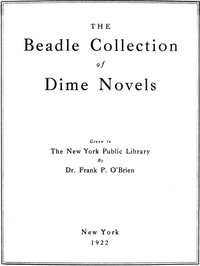
The Beadle Collection of Dime Novels, as cataloged by the New York Public Library in 1922, documents over 1,400 titles from the house of Beadle and Adams, the firm that launched the dime novel phenomenon in 1859. The catalog lists works by authors such as Edward S. Ellis, Ann S. Stephens, and Mary A. Denison, with titles like The Boy Miners and The Indian Queen. The collection, donated by Dr. Frank P. O’Brien, includes thirty-one distinct series, ranging from little 24mos to large folio sheets, many in illustrated covers of brown, blue, orange, tan, green, yellow, red, and buff.
The catalog’s preface emphasizes the collection’s historical value, noting that these books “exercised a profound influence on the country’s thought, character, and habits of mind.” The entries reveal recurring patterns: frontier adventures, Revolutionary War tales, sea stories, and romances, often with formulaic subtitles like “A tale of the settlements” or “A romance of real life.”
Publishing Formats and Physical Variety
The catalog records an extraordinary range of physical formats. The Beadle publications came in sizes from “little 24mos to large folio sheets as big as a modern newspaper.” More than half of the series were originally issued in illustrated wrappers of different colors, and the catalog lists them in brown, blue, orange, tan, green, yellow, red, buff, and combinations of those hues, as well as plain black-and-white. The exhibition displayed these covers to reveal their outward appearance and the “dramatic or quaint illustrations” that embellished them. Certain books were opened to show title pages, while others were shown closed to preserve the cover art. This attention to materiality underscores how the dime novel’s appeal depended as much on its visual packaging as on its text.
Recurring Narrative Patterns
The titles and subtitles in the catalog reveal a set of narrative formulas that recur across authors and series. Many stories are set during the American Revolution, such as Captain Molly; or, The fight at Trenton, Christmas, 1776 and The unknown. A tale of 1777. Frontier and Indian captivity narratives appear frequently, like Wingenund, the young trail-hunter; or, The death of War-Eagle and The pale-face squaw; or, The last arrow. Sea tales are also common, including The sea captain; or, A cruise for honor and The privateer’s cruise, and the bride of Pomfret Hall. A sea tale of ’76. Romances with sensational elements, such as Myra, the child of adoption. A romance of real life, mix domestic drama with adventure. The catalog’s entries thus map a literary landscape where conflict, exploration, and sentiment are tightly interwoven.
Authorship and Pseudonyms
The catalog lists a mix of well-known and obscure authors, many using pseudonyms. Ann S. Winterbotham Stephens appears with The Indian queen and Myra, the child of adoption. Edward S. Ellis contributes The rangers of the Mohawk and The boy miners. Mary Andrews Denison writes Captain Molly and Ruth Margerie. Pseudonyms are common: “Clara Augusta” is Kate Nichols Trask, author of Winifred Winthrop; “N. C. Iron” produces The unknown and The double hero. The catalog also notes sequels, such as Wingenund being a sequel to The white brave. This network of names and aliases suggests a collaborative and commercial writing culture, where authors produced multiple titles under different bylines to meet the insatiable demand for new stories.
The catalog’s entries, though brief, offer a window into the dime novel’s role in shaping American popular culture. Readers interested in the evolution of genre fiction, the history of publishing, or the material culture of cheap print will find this record a valuable starting point. The collection’s diversity—from Revolutionary War tales to frontier adventures and sea stories—invites exploration of how these formulaic narratives both reflected and influenced their audience’s imagination.
I have spent many quiet afternoons with the Beadle catalog, that sturdy ledger of penny adventures, and it always brings to mind a more polished shelf—the List of Books in Belles Lettres Published by John Lane, The Bodley Head, 1895 — A Closer Reading. Both are inventories of hope, one in worn paper, the other in fine cloth, sharing a hush between covers.










![Cover of Selected List of Nimmo, Hay, & Mitchell's Publications [1890] — Text and Context](https://rrola.com/storage/media/covers/pg36649.jpg)